NiFreeze
Model-based estimation and correction of head motion and eddy current distortions in 4D neuroimaging.
NiFreeze is a flexible framework for volume-to-volume motion estimation and correction in d/fMRI and PET, and eddy-current-derived distortion estimation in dMRI.
Diffusion and functional MRI (d/fMRI) generally employ echo-planar imaging (EPI) for fast
whole-brain acquisition.
Despite the rapid collection of volumes, typical repetition times are long enough for head motion
to occur, which has been proven detrimental to both diffusion [1] and functional [2] MRI.
In the case of dMRI, additional volume-wise, low-order spatial distortions are caused by
eddy currents (EC), which appear as a result of quickly switching diffusion gradients.
Unaccounted for EC distortion can result in incorrect local model fitting and poor downstream
tractography results [3], [4].
FSL’s eddy [5] is the most popular tool for EC distortion correction, and
implements a leave-one-volume-out approach to estimate EC distortions.
However, FSL has commercial restrictions that hinder application within open-source initiatives
such as NiPreps [6].
In addition, FSL’s development model discourages the implementation of alternative data-modeling
approaches to broaden the scope of application (e.g., modalities beyond dMRI).
NiFreeze is an open-source implementation of eddy’s approach to estimate artifacts
that permits alternative models that apply to, for instance, head motion estimation in fMRI
and positron-emission tomography (PET) data.
Like eddy, NiFreeze estimates each volume’s motion and distortion with a
leave-one-volume-out scheme: a signal model fit on all the other volumes
synthesizes an independent, same-contrast registration target for the held-out
volume, sidestepping the ill-posed volume-to-volume registration of
direction-varying dMRI contrast.
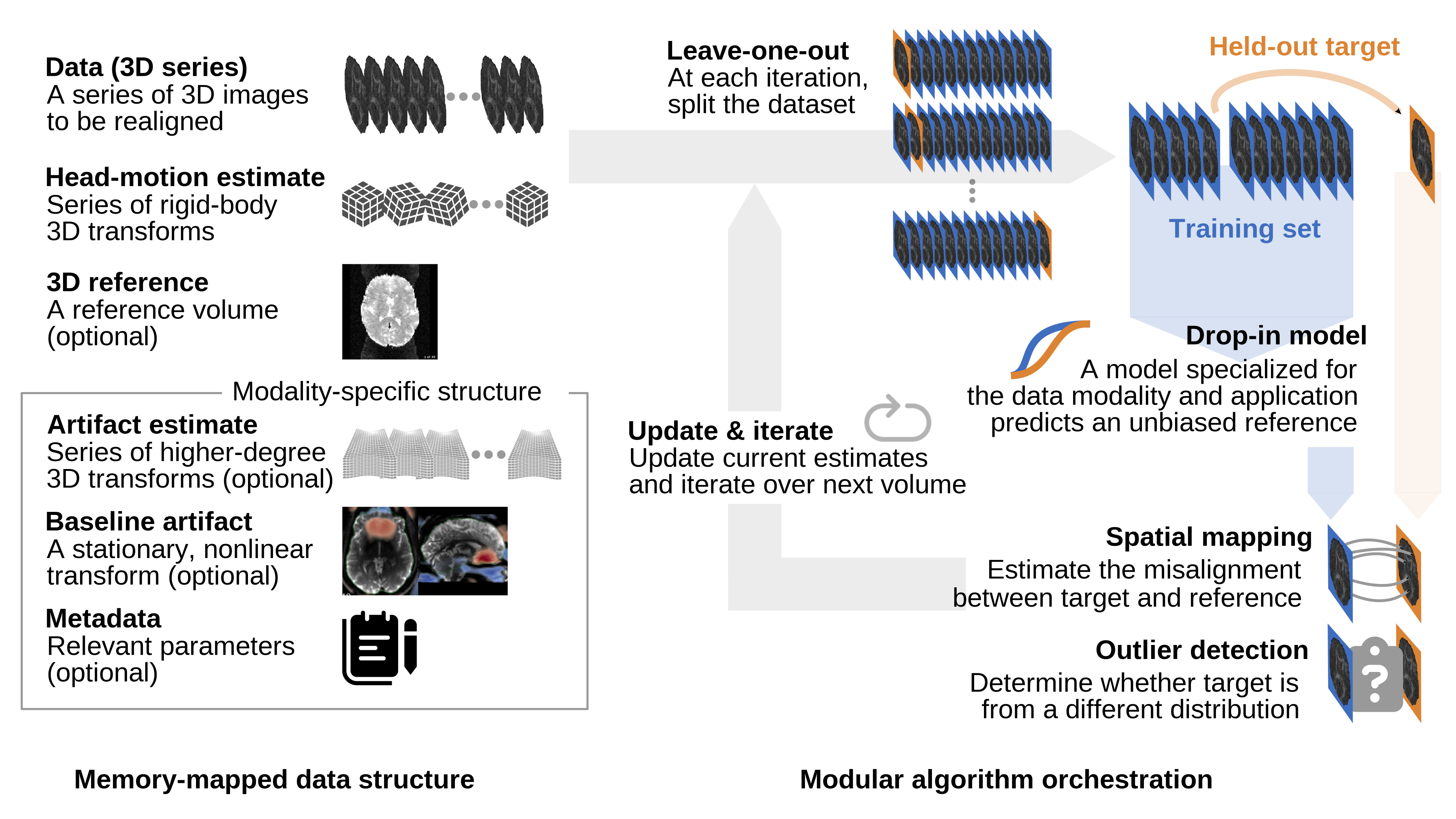
NiFreeze succeeds eddymotion, whose repository is archived; its contributors are listed in .maint/EDDYMOTION.md.
Contents
- Installation
- Design Principles
- Extending NiFreeze
- Contributing to NiFreeze
- Model implementation
- Prediction gallery
- How to Use
- Running NiFreeze
- Citing NiFreeze, and writing papers about it
- For developers
- Synthetic reference data
- Registration accuracy
- Experiment-driven development
- What’s new?
- References